(I know there are a lot of facts in this blog, but I don't want to forget what we saw...so, you can read or you can just check out the pictures, Be sure to go to the blog so you can watch the video at the end, if you get this in an email)
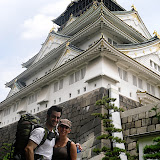
Friday morning we woke up and took a tour of Kyoto and Nara through a tour agency we found online. It was 100% worth it, we had the sweetest tour guides, a good lunch and a ton of temples. Our first stop was the Nijo Castle. It was the Kyoto home of a Samaurai Shogunite.  In 1601, Tokugawa Ieyasu, the founder of the Tokugawa Shogunate, ordered all the feudal lords in Western Japan to contribute to the construction of Nijō Castle, which was completed during the reign of Tokugawa Iemitsu in 1626. Parts of Fushimi Castle, such as the main tower and the karamon, were moved here in 1625-26.[1] It was built as the Kyoto residence of the Tokugawa Shoguns. The Tokugawa Shogunate used Edo as the capital city, but Kyoto continued to be the home of the Imperial Court. Kyoto Imperial Palace is located north-east of Nijo Castle.
The central keep, or donjon, was struck by lightning and burned to the ground in 1791.
In 1788, the Inner Palace was destroyed by a city-wide fire. The site remained empty until it was replaced by a prince's residence transferred from the Kyoto Imperial Palace in 1893 .
.
In 1867, the Ninomaru Palace was the stage for the declaration by Tokugawa Yoshinobu, returning the authority to the Imperial Court. Next year the Imperial Cabinet was installed in the castle. The palace became imperial property and was declared a detached palace. During this time, the Tokugawa hollyhock crest was removed wherever possible and replaced with the imperial chrysanthemum.
In 1939, the palace was donated to the city of Kyoto and opened to the public the following year.
We were not able to take photos inside of the main building, but the home was huge. It had intricate paintings on all of the paper sliding doors between the rooms. The floors were built in a manner that when people walked on them they made the sounds of a nightingale. This was so that they knew if there were intruders.
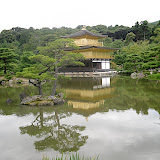
Our next stop was the Kinkakuji Temple, or the Golden Pavilion which was one of my favorite stops. The reflection of the building in the water was breathtaking.
 Kinkaku-ji was originally built in 1397 to serve as a retirement villa for Shogun Ashikaga Yoshimitsu, as part of his estate then known as Kitayama.[1] It was his son who converted the building into a Zen temple of the Rinzai school.
The temple was burned down twice during the Ōnin War.
On July 2, 1950 at 2:30 am, the pavilion was burned down by a monk named Hayashi Yoken, who then attempted suicide on the Daimon-ji hill behind the building. He survived, and was subsequently taken into custody. During the investigation after the monk's arrest, his mother was called in to talk with the police; on her way home, she committed suicide by jumping from her train into a river valley. The monk was sentenced to seven years in prison, but was released because of mental illness on September 29th, 1955; he died of other illnesses shortly after in 1956. During the fire, the original statue of Ashikaga Yoshimitsu was lost to the flames (now restored).
The present structure dates from 1955. In 1984, the coating of Japanese lacquer was found a little decayed, and a new coating as well as gilding with gold-leaf, much thicker than the original coatings (5/10,000mm instead of 1/10,000mm), was completed in 1987. Additionally, the interior of the building, including the paintings and Yoshimitsu's statue, were also restored. Finally, the roof was restored in 2003.
 The heart of the temple complex is the Golden Pavilion (kinka-ku), situated picturesquely in its garden at the edge of a lake. This layout is typical of the Shinden style of the Heian period and is intended to suggest a position between heaven and earth. The pavilion extends partially over the pond and is beautifully reflected in the calm waters. It is one of the most beautiful sights in Kyoto.
The wooden pavilion has three stories surrounded by balconies, the upper two of which are completely covered in gleaming gold leaf. As mentioned above, the shogun only managed to coat the interior ceiling with gold during his lifetime, but always intended to cover the outside as well. On a sunny day, it can be difficult to look at without sunglasses!
In addition to its worldly treasure, Kinkakuji is highly valuable because it is a shariden, housing relics of the Buddha.
The first floor of the pavilion, known as the Hôsuiin ("Temple of Dharma Water"), is built in the shinden style (shinden zukuri) associated with 11th-century Heian nobility. The walls separating it from the balcony only rise half-way, allowing plenty of light and fresh air into the room.

The second story, called the Chôondô (alternatively translated "Grotto of Wave Sounds" or "Tower of Sound Waves"), is built in the buke style (buke zukuri) of samurai houses. It houses a statue of Kannon.
The third floor of Kinkakuji is built in the style of a Buddha Hall in a Zen temple and is known as the Kukkyôchô ("Superb Apex"). It has round-headed windows and is more richly ornamented than the other floors. Inside, it shelters an Amida triad and 25 Bodhisattvas. The roof is topped with a golden Chinese phoenix.

We both made wishes.

The Imperial Palace was our last stop on the tour of Kyoto and it was huge. I would have to say that I wasn't as impressed though as I was with the Golden Pavilion. Rock space gardens took up most of the property of the Imperial Palace.

Kyoto Gosho (京都御所, Kyōto Gosho), or Kyoto Imperial Palace, was the Imperial Palace of Japan for much of its history, from the Heian Period, when the Imperial capital was moved from Nara to Heian-kyo (平安京), now called Kyoto, until the Meiji Restoration, when the capital was moved to Tokyo. However, the Taisho and Showa Emperors still had their coronation ceremonies at Kyōto Gosho. Today, the grounds are open to the public, and the Imperial Household Agency hosts public tours of the buildings several times a day (see restrictions below).
The buildings and grounds
The Palace, like many of the oldest and most important buildings in Japan, was destroyed by fire and rebuilt many times over the course of its history. Since it was first built in 794, it has been destroyed and rebuilt eight times, six of them during the 250-year-long peace of the Edo Period. The version currently standing.
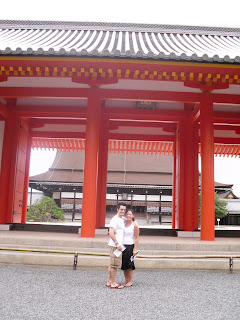
The Palace Grounds includes a number of buildings, along with the Imperial Residence, or daidairi (大内裏). The neighbouring building to the north is the sentou (仙洞), or residence of the retired Emperor, and beyond that, across Imadegawa Avenue, sits Doshisha University. The Imperial Household Agency maintains the building, and the grounds, which are generally known as Kyoto Public Gardens, or Kyōto Gyoen (京都御苑).
The main building on the Palace Grounds includes, among other halls, the Shishinden (紫宸殿, Hall for State Ceremonies), Seiryōden (清涼殿, lit. 'cool, refreshing hall'), Kogosho (小御所, Court Room), Ogakumonsho (御学問所, Imperial Study or Library), and a number of residences for the Empress, high-ranking aristocrats and government officials.

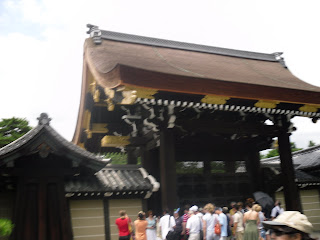
The main gate on the front, south, side of the Palace has a cypress-wood roof, and is supported by four pillars. On either side of it were planted trees which would become very famous and sacred, a cherry (sakura) on the left, and a tachibana tree on the right. This gate would have been used on the rare occasions of the Emperor welcoming a foreign diplomat or dignitary, as well as for many other important ceremonies of the State. To the sides lies a fence separating the inner areas from the general Palace Grounds, and just past this main gate is a second gate, painted in vermillion and roofed in tile, which leads to the Shishinden, the Hall for State Ceremonies. The Shishinden was used for such important ceremonies as the coronation of an Emperor and installation of a Crown Prince. It is 33 by 23 meters in size, and features a traditional architectural style, with a gabled and hipped roof.

The center of the Shishinden is surrounded by a hisashi (庇), a long, thin hallway which surrounded the main wing of an aristocrat's home, in traditional Heian architecture. Within this is a wide open space, crossed by boarded-over sections, leading to the central throne room. The Throne itself, called takamikura (高御座), sits on an octagonal dais, five meters above the floor, and could be separated from the rest of the room by a curtain. The sliding door that hid the Emperor from view is called kenjou no shouji (賢聖障子), and had an image of 32 Chinese saints painted upon it, which became one of the primary models for all of Heian period painting.

The Seiryōden sits to the west of the Shishinden, facing east. It, too, has a hipped and gabled roof, and is comprised primarily of cypress wood. Originally a place where the Emperor would conduct his own personal affairs, the Seiryouden was later used for various gatherings and meetings as well. In the center is an area where the Emperor would rest, and on the east side of the hall, an area of two tatami was set aside for dignitaries and aristocrats to sit. Here was where the Emperor could conduct formal affairs. On the north side of the hall was an enclosed area where the Emperor would sleep at night; later, Emperors began to use the official residence (daidairi). The west side was set aside for the Emperor's breakfasts, and also contained the lavatories, while the south side was used by the keeper of the Imperial Archives. This area contained paintings by the masters of the Tosa school, and just outside, various rare bamboos were planted.

We hopped back on the bus for an hour long ride to Nara, which was a city a bit farther from the hustle and bustle of Kyoto. Our first stop was The Deer Park. Inside 1200 deer roam wild but are used to people being around and walk straight up to you to pet. Hidden, well not really hidden but within the Deer Park is the Todaiji Temple. It is the largest wooden structure in the world and holds the largest Buddha in Japan.

Todaiji (Great Eastern Temple) is one of Japan's most famous temples and a landmark of Nara. Located in Nara Park, in central Nara, Todaiji was constructed in 752 as the head temple of all provincial Buddhist temples of Japan.
Todaiji derives its name from its location east of Nara, which was the capital of Japan when it was built. Today, the temple serves as the Japanese headquarters of the Kegon school of Buddhism.
The monastery-temple Todaiji was founded by Emperor Shomu (r.724-749) when Nara was the capital of Japan. It was the head temple of the network of provincial monasteries throughout Japan.

Immense in scale (significantly larger than the temple that stands today), Todaiji represented the culmination of imperial Buddhist architecture.
Todaiji is a temple of the Kegon sect of Buddhism, which reveres the Buddha Vairocana (Birushana in Japanese) as the cosmic, central Buddha. The principal image of the temple is a bronze statue of Vairocana, colossal in scale.
According to legend, nearly 2,600,000 people helped construct the Buddha — but as that would amount to nearly the half of the people in Japan at the time, the figure is probably exaggerated. Nevertheless, by the time the Buddha was completed in 751, it had consumed most of Japan's bronze production for several years and left the country almost bankrupt.

The Great Buddha was finally dedicated in 752 with great pomp and ceremony. The emperor and his family were present for the occasion, as were hundreds of local monks and ambassadors from China, India and more distant places.
The statue was dedicated by "opening his eyes" — an Indian priest stood on a specially built platform and painted in the eyes using a gigantic brush. The guests brought a dazzling assortment of gifts, many of which have been preserved in the Shoso-in treasury, along with the original paintbrush.

Popularly called the Nara Daibutsu (Great Buddha of Nara), the statue was installed in the huge Daibutsuden (Great Buddha Hall). By 798 the vast temple compound of Todaiji was completed.
Todaiji temple grew so powerful that the Japanese capital was moved from Nara to Nagaoka in 784 in order to lower its influence on government affairs. The temple remained active, and its wooden buildings were rebuilt several times over the centuries after fires and earthquakes.
After most of the buildings were destroyed in 1180, Todaiji was reconstructed under the abbot Shunjobo Chogen (1121-1206) in a style he saw in China. This style can still be seen in the Nandaimon (Great Southern Gate), for which the famed sculptors Unkei and Kaikei made the impressive guardian statues in 1203.
Todaiji was again greatly damaged in 1567; it was rebuilt by the Tokugawa shogunate in 1692. The Daibutsuden that stands today dates for the most part from 1709 and is two-thirds the size of the original. Little remains of the orirginal 8th-century buildings of Todaiji, except the Tegai Gate of the western wall and the inner sanctuary of the hokkedo.
The Great Buddha statue has also been damaged, especially due to earthquakes, and recast several times. The current statue dates from 1692.

The main entrance to the temple is through the 13th-century Nandaimon (Great Southern Gate). It features two impressive guardian statues of the Nio (Benevolent Kings), carved in 1203 and each more than 8 meters tall.
Todajji's main temple building, the Daibutsuden (Great Buddha Hall), is said to be the largest wooden building in the world. This is especially impressive in light of the fact that the present reconstruction (from 1692) is only two thirds of the original temple's size.
The original complex also contained two 100-meter-high pagodas, probably the tallest buildings in the world at the time, but these were destroyed by earthquake.

Todaiji is famous for housing Japan's largest Buddha statue. It depicts the Buddha Vairocana and, like the one at Kamakura, is commonly known as the Daibutsu (Great Buddha). The Daibutsu is made of copper and bronze, weighs 250 tons and stands 30 meters tall. His intricate hairstyle is made of 966 bronze balls.
Also of interest in the Daibutsuden are the rear support pillars, which have holes through the bottom. Popular belief has it that if one is successful in squeezing through one of these "healing pillars," he or she is guaranteed a place in Heaven.
Outside the Daibutsuden at the bottom of the steps, don't miss the bronze Octagonal Lantern, one of the oldest treasures in Todaiji — it dates from the original 8th-century temple. The lantern's support post is inscribed with a Buddhist text on the merits of lighting lanterns.
The last stop on our trip was Kasuga Shrine. There are over 4000 lanterns outside of the Shrine. It is a Shinto Shrine, which is a pretty cool religion now that we have learned about it. They do not pray to any "god" but rather to all the precious things on our earth. For instance, they pray to the trees for shelter, food, clothing and life and so on. They value each piece of nature for what it gives to us in this world.
 The Kasuga Shrine (春日大社, Kasuga-taisha) is a Shinto shrine in the city of Nara, in Nara Prefecture, Japan. Established in 768 A.D. and rebuilt several times over the centuries, it is the shrine of the Fujiwara family. The interior is famous for its many bronze lanterns, as well as the many stone lanterns that lead up the shrine.
The architectural style Taisha-zukuri takes its name from the Kasuga Shrine.

The Kasuga Shrine, and the Kasugayama Primeval Forest near the shrine, are registered as a UNESCO World Heritage Site as part of the "Historic Monuments of Ancient Nara".
The shrine became the object of Imperial patronage during the early Heian period.[1] In 965, Emperor Murakami ordered that Imperial messengers were sent to report important events to the guardian kami of Japan. These heihaku were initially presented to 16 shrines including the Tatsuta Shrine.
From 1871 through 1946, the Kasuga Shrine was officially designated one of the Kanpei-taisha (官幣大社), meaning that it stood in the first rank of government supported shrines. The shrine became the object of Imperial patronage during the early Heian period.In 965, Emperor Murakami ordered that Imperial messengers were sent to report important events to the guardian kami of Japan. These heihaku were initially presented to 16 shrines including the Tatsuta Shrine.

From 1871 through 1946, the Kasuga Shrine was officially designated one of the Kanpei-taisha (官幣大社), meaning that it stood in the first rank of government supported shrines. The shrine became the object of Imperial patronage during the early Heian period. In 965, Emperor Murakami ordered that Imperial messengers were sent to report important events to the guardian kami of Japan. These heihaku were initially presented to 16 shrines including the Tatsuta Shrine.
From 1871 through 1946, the Kasuga Shrine was officially designated one of the Kanpei-taisha
(官幣大社), meaning that it stood in the first rank of government supported shrines.
On the bus, our tour guide told us a Japanese comedy theatre act. I hope you can hear, it is funny.
A link to the Nara Photo's (Kyoto will be in our next blog)

 the chain but the sheer fact that they probably look in the mirror and say "konnichiwa!!!!" is a-ok.
 nobody cares but me but the cars were pretty cool i thought. First of all, in South Korea, everything is a hyundai or Kia so the variety really isn't there. Japan, however made me feel like i'd never seen cars before. What I mean is all the models that Honda, Toyota, Nissan and Mazda have over there that we never get in the states. Not to mention the nissan skylines that showed up around every corner which to me is kinda like seeing Angelina Jolie covered in metal and carbon fiber.